
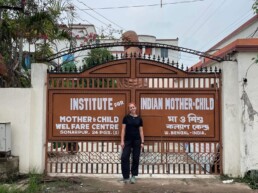
Matilda: En resa som sätter perspektiv på tillvaron
Matilda Berglund
En resa som sätter perspektiv på tillvaron
Att vara volontär på andra sidan jorden i ett land som strukturellt och kulturellt är så annorlunda från Sverige har verkligen satt perspektiv på min tillvaro. Problem som jag hade tidigare har nu blivit bagateller och det är så många små saker i min vardagsmiljö jag tagit för givet som jag nu lärt mig att uppskatta. Så som en buss som kommer i tid, att alltid ha rent rinnande vatten och elektricitet, eller en ren stadsmiljö. Tänk bara att få ha vuxit upp och leva i ett land där sjukvård och utbildning är gratis för alla. Vilken lyx och vilka möjligheter vi har. Det måste vi vara tacksamma för och ta vara på, och kämpa för att andra, mindre lyckligt lottade, också kan få den lyxen.
Jag var volontär hos IIMC i Kolkata i Indien i juni 2025, precis efter att jag gått ut termin 4 på läkarprogrammet. Jag minns att april och maj innan jag reste var ganska stressiga med mycket fixande: vaccinationer, visumansökan, tentaplugg. Så när jag väl satt på planet kändes det som att jag äntligen kunde andas ut. Men inte länge till! Jag landade mitt i natten och fick glatt vänta på flygplatsen tills morgonen grydde då jag blev upphämtad av en av IIMCs chaufförer. Ut i Kolkatas myllrande morgontrafik for vi. Och jag var helt mållös. Jag har tidigare varit utomlands i andra världsdelar som sett väldigt annorlunda ut jämfört med Sverige, men detta var något annat. Bilar, mopeder, färgglada bussar, cyklister, djur och människor dragandes på stora kärror trängdes på gatan och jag slogs av en kakafoni av nya intryck.
Vi åkte igenom nästan hela stan på väg till IIMCs kontor och passerade både lyxiga villor men även slumområden. Redan där, första morgonen i bilen, insåg jag hur fattigt vissa människor lever i Kolkata. Där mitt i den enorma staden, mitt på gatan, bor människor i små skjul av presenning, kartong och, om man har tur, ett metalltak. De tvättar sig mitt på öppna gatan, lagar mat över öppen gaslåga och sopar bort det aldrig sinande stadsdammet framför sina presenningshus med en liten kvast. Vilken fattigdom, tänkte jag. Det var innan jag förstod att det ofta anses som en lyx av folk på landsbygden att ha möjlighet att bo i ett slumkvarter inne i staden.
Första veckan var det mycket nytt som man skulle vänja sig vid. Mitt rum som jag bodde i såg ut som en liten fängelsehåla. Sängen var av metall med en smal madrass, det var spindelnät i hörnen och bredvid den tröga fläkten i taket hängde ett ensamt myggnät. Det var oerhört varmt och jag vaknade varje morgon i en pöl av svett, med blåmärken på höfterna eftersom sängen var så hård. Om jag ska vara ärlig tyckte jag att det var ganska jobbigt de första dagarna. Men låt inte detta avskräcka dig. Alla de andra upplevelserna första veckan var fantastiska. I juni var vi bara fyra volontärer och vi blev runtvisade av maj-volontärerna som guidade oss i hur man tog kollektivtrafik och tuk-tuks till och från kliniken, hur man skulle tänka kring inköp av mat och allt annat praktiskt. Det var väldigt skönt att få hjälp med allt sånt!
Jobbet på IIMCs vårdcentraler startade ganska direkt. IIMC har ett gäng vårdcentraler där några ligger ute på landsbygden, vissa närmare stan och de har öppet olika dagar i veckan. Vi volontärer åkte med läkare och sjuksköterskor från IIMCs huvudkontor till de olika vårdcentralerna i princip varje dag. Vi fick under mina fyra veckor hjälpa till mycket med att bland annat ta blodtryck, ge intramuskulära injektioner och vaccin, tvätta och smörja in svampinfektioner, olika slags sår och eksem. Vi fick ofta sitta med när läkarna gjorde bedömningar på patienter. Det är ofta flera hundra patienter som vill ha hjälp varje dag på dessa vårdcentraler vilket leder till att efter en snabb initial bedömning slussas patienten vidare till olika vårdrum beroende på vad de behöver hjälp med. De som får träffa en läkare får ofta inte mer än ett par minuter på sig att förklara sina problem. För mig som precis läst samtalsteknik i skolan blev detta lite av en chock men jag blev snabbt varse att alternativet för dessa patienter var ingen vård alls, då de inte hade råd med något annat. Både läkarna, sköterskorna, patienterna och vi volontärer fick helt enkelt göra det bästa av situationen, med de medel och resurser som vi hade tillgängligt där och då.
IIMC har inte bara sjukvård utan driver även andra projekt där kvinnor och barn är i fokus. Bland annat var vi flera gånger och besökte IIMCs skolor som finansieras av månadsgivare över hela världen. Vi deltog på möten med olika Women’s peace council som är grupper för kvinnor i byarna där syftet är att stärka kvinnornas ställning i samhället. Det görs bland annat genom att lyfta och diskutera olika problem och tillvägagångssätt, och en sådan enkel sak som att varje dag gemensamt läsa dagstidningen kan vara väldigt värdefull i dessa grupper där många är analfabeter.
En helg fick vi ledigt torsdag till söndag och då åkte vi alla fyra volontärer nattbuss norrut upp till byn Darjeeling som ligger precis vid starten på bergskedjan Himalaya. Där vandrade vi, drack te och fick njuta av lite av Indiens fantastiska natur. Lugnet och den betydligt svalare temperaturen i Darjeeling stod i stor kontrast till storstaden Kolkatas smuts, värme och myller. Det var väldigt häftigt att få uppleva båda delarna och jag är väldigt glad för vår lilla weekend-trip.
Även i Kolkata hade vi mycket tid till turistande. Vissa arbetsdagar var väldigt långa, medan andra var korta och då kunde vi fara ut i staden och upptäcka allt vad den hade att erbjuda! Vi åt massa spännande mat, gick på häftiga marknader, upptäckte tempel och små gator och gränder. Vi fick massa hjälp och tips från IIMCs personal som nästan alla var födda och uppvuxna i Kolkata och som var ivriga att få dela allt det bästa av sin härliga stad. Vi blev även medbjudna på middag flera gånger av Dr. Sujit, och utdragen på klubbkväll av hans dotter Subarna som var i vår ålder och själv studerar till läkare i Kolkata. Att umgås med henne tyckte jag var jättespännande, att få veta lite mer hur en annan läkarstudents vardag kan se ut på andra sidan jorden.
Fyra veckor svischade förbi och snart var det dags för hemfärd. Helt plötsligt var jag själv den där coola, självsäkra, gamla volontären som fick visa nykomlingarna hur man tog sig runt i stan och vilken den bästa matbutiken var. Väl hemma i Sverige kändes det nästan som att resan till Indien hade ägt rum i ett annat liv. Jag är så tacksam för att jag fick möjlighet att resa och få uppleva allt Kolkata hade att erbjuda, det är erfarenheter jag kommer bära med mig för livet. Jag uppmanar alla som har möjlighet att åka på något liknande att ta chansen. Du kommer inte ångra dig!
**Matilda Berglund, läkarstudent, Uppsala universitet**
**IIMC volontär juni 2025**

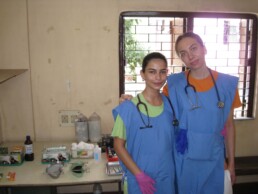
Kolkata: Englas reseberättelse
Engla Fjellström
Det är september på BMC och det har knappt gått två veckor sedan jag anlände hem till Sverige. Kolkata börjar kännas ofrivilligt avlägset trots den aldrig sinande källan av upplevelser och intryck därifrån. Det kanske inte är så konstigt sett till den enorma diskrepansen mellan mitt liv där och här, en nylig upplevelse på en främmande plats. För att få någon storts struktur på den här texten istället för diffusa känsloyttringar tar jag till fotoalbumet där jag och mina volontärkollegor, tillika vänner delade våra minnen. Sonanpurs färgglada fasader, ihopplock till middagar på boendet, medicinsk utrustning och till övervägande del vi volontärer finnsavbildade där. Det första jag noterar i min skiss till den här texten är att jag saknar det enormt mycket!
Att vara volontär är en utmaning, det är att göra avkall på sina egna föreställningar om världen, på sin bekvämlighet och sina sanningar. Vissa av mina övertygelser har blivit befästa, medan andra rubbets helt. Den här månaden är av just den anledningen något jag betraktar från ett personligt perspektiv, inte enbart som blivande läkare. Jag är tacksam för- och framför allt stolt över att vara en del av IIMC och den sedan 1990-talet löpande kedjans av internationella ideella. För det är ju så, att det månad anländer ett antal, allt från två till tjugo volontärer till Kolkata för att vara en länk i den. Alla kommer med olika förväntningar; vissa vill rädda världen, vissa vill förstå den och många har en helt annan och högst individuell orsak. För att hålla mig kortfattad så ville jag förstå den mer än något annat, vilket skulle visa sig vara lite mer invecklat än vad jag hade trott. Ett rent medicinskt perspektiv som blev en av de första funderingarna jag stötte på var frågan om hur mycket jag faktiskt kan hjälpa. På outdoorklinikerna fick vi volontärer ett papper i handen med vad som skulle kunna tänkas lindra. Injektioner av diklofenak, vitamin B, tetanus och gentamicin, omläggning av hudsjukdomar med quickderm, gyentrop, clotrimazole, tvätt av sår med jodlösning. Efter några veckor, och efter att ha suttit med läkare på olika outdoorkliniker förtid jag hur många som lider av kroniska sjukdomar, långt gångna lungsjukdomar och kraftiga ledsmärtor. Det innebar också att jag förstod hur mycket arbete som finns kvar att göra för att ge adekvat hjälp. Jag upplevde en sorts strukturell- snarare än personlig maktlöshet inför detta, samtidigt som en lättnad över att kunna hjälpa till att lindra smärta.
Det medicinska projektet är bara en del av IIMC:s program, och upplevelsen av att arbeta med IIMC är bara en del av det omvälvande med att vara på plats i Västbengalien. Jag glömmer aldrig våra dagar i Dhaki där sju volontärer hopträngda på en flakmoppe fick se solnedgången på väg till en avlägsen by. Ännu mindre glömmer jag när bilen på väg tillbaka från Dhaki gick sönder och vi fick åka det lokala tåget istället. Åtta personer i en tuktuk på väg hem from mozzarellaprojektet, vinsten i månadens fotbollsmatch(!), när Salomea fick i arbetsuppgift att plantera ut fiskar i en damm och när vi firade Benedettas födelsedag på den indiska landsbygden. Vår första upplevelse av konceptet ”Indian Time” och instruktionen ”If we say there will be a meeting at four, it means there might be a meeting sometime after four”. Högt som lågt, i stort helt oförglömligt. Upplevelsen av att tillbringa så mycket tid tillsammans i så många nya situationer för en grupp samman. Man är ensam på plats och från vitt skilja länder, men lyckas skapa en känsla av temporärt hem tillsammans.
Insikten om mina- och programmets begränsningar var en viktig insikt som gjorde mig mycket mån om programmets framtid och utveckling. Som volontär räddar man inte världen, ty organisationen har mer erfaren intern kompetens. Vi är utbytbara, oerfarna och kastas in i ett samhälle vi vet mycket lite om. Men att just detta är vår styrka, rulliansen i volontärer som månad för månad förblir ödmjuka inför människor i otroligt utsatta situationer, och förhoppningsvis på sikt lyckas göra en skillnad. Min tid i Kolkata gav mig fler nya perspektiv än jag kan räkna, och jag har den att tacka för väldigt mycket. Det är omvälvande, vilket är dess storhet som upplevelse.
**Engla Fjellström, T2, Läkarprogrammet Uppsala**\
**IIMC volontärprogrammet 2026**

Kolkata is an experience
Kolkata is an experience
A month in Kolkata is an experience. It is an adventure involving human relations, cultural shocks, and language barriers. And not to forget, an opportunity to get lost in the amazing and lively Indian culture.
With IIMC, it’s important not to arrive with the expectation of saving the world. Because you will not. But this project is a small part of the puzzle to make the world become a better place. For you this is an incredible opportunity to observe a very well-functioning human development project; to see the wide spectrum of people who benefit from the project, and to meet the local volunteers who keep this project going. Some of them were even on the receiving end of help just a couple of years before. The project renews and recycles itself.
As the volunteers are changing every month, the locals are the perennial part of the project. Like many others, I faced the question: does my presence here matter? Dr. Sujit has had this question many times before and he had a good answer: the foreign volunteers are the catalyst to keep the chemical reaction that is IIMC going. The volunteers are also there to show the poor people of Kolkata that the world cares about their situation.
But to me this month was most important for me as a person. It is not what I brought to Kolkata but what I learned. I got to practice some easy medical procedures but the main experience was all the wonderful and strong people I met from all over the world. I will always carry this adventure with me in my future medical career and personal development.
P.S. Pro tip if going:
Always bring a snack. You never know how long a meeting will last. It is better to be ready for anything and to keep the blood sugar stable. D.S.
Pernilla Stam, Medical student T3, Lund
IIMC volunteer August 2017

A Long Awaited Journey
A Long Awaited Journey
I have long wanted to go to India, and when I learned that students went to Kolkata in previous years to do their candidate work for the fifth term at the medical program together with IIMC, I didn’t delay my application. To my great joy, my class mate Alma was as excited as me and we started planning for the summer before we started the fourth term. It has been a long process that has not yet ended. At the time of writing (June 2017), we have completed our essay, which we will present later in August.
Today, it’s Wednesday lunch and it is Swedish summer outside the window. The weather app says that it is 16 degrees and pouring rain in Lund. In Kolkata, it is late afternoon and 34 degrees. 34 degrees sounds unusually chilly to my ears. But I suppose that the rainy season has started now and that’s why it has become colder. If there is one thing that I’ll never forget, it is the heat during the month of May in Kolkata. I didn’t think that my body was capable of sweating that much. But now I know and am instead grateful for the body’s fantastic ability to adjust to temperatures. It is hard to imagine that only a couple of days ago, we were in the middle of the morning rush hour in Kolkata on our way to the clinic in Sonarpur. And when I say morning rush hour, perhaps mid-morning rush hour is more accurate – because at 8am, the subway is only just open!
It has been an incredible journey and I am so glad that I got the opportunity to do this journey in conjunction with my candidate work. Working with the IIMC has given us a unique insight into living in India, which we could not have experienced otherwise. We have seen disorders that I do not think we will ever see in Sweden, and we have taken so many blood pressure tests that we are still sore in our ears! We have met so many people who live starkly different lives than we do in Sweden.
However, I would not recommend anyone to go in May, since it’s the hottest month of the year! But the heat was an experience in itself. If it’s your only chance to make this trip in May, I can recommend that you pack plenty of Resorb in your suitcase. And it’s best to travel with a friend – everything is much more fun and easier when you are two – especially in a country where the culture is so different.
India is such a fantastic country that has taught us so much in just five weeks that it’s hard to even try to cover more than a fraction of it in a blog post.
It is fascinating how fast you get used to a new life. And how fast your new life after 24 hours on Swedish soil suddenly feels like a distant dream. But the memories of this trip I know I will carry with me for the rest of my life: the lunches outside the clinic where we happily waited for our naan bread for over 40 minutes, because there were some shadow and a fan; the time we got to ride on the disco-rickshaw with speakers that played Barbie Girl at the highest volume all over Sonarpur; the families in Dhaki who gave us coconuts; the bodies burning in Varanasi; the never-ending line with people who wanted to take selfies; the feeling of getting into a cafe or an Uber with AC in it; the fantastic food; the joy that is was ‘mango season’; the brown sludge that was left in my washing water when I rinsed my clothes after a long working day; the cool evening, morning and afternoon showers; the traffic noises; the dogs who bark late at night; the smell of incense and stench from burned garbage; all the people… Amazingly, I do not think I’ve seen two women wear the same sari more than once, there are so many different beautiful patterns and colours there. All this and so much more, I will remember when I think back on my time in Kolkata.
But I will also think about the little child who had played to close to her mother when she cooked food – resulting in horrible burns all over her leg. And how I stood there with a single instruction in my hand: “gentamicin”. I think of all those people who came to the clinic to get injections and pain killers, when it was obvious that they need so much more than just that. People with advanced diabetes, who would have? needed amputation long ago.
But it is not possible to compare anything with Sweden, for these clinics in India are so different from those in Sweden. And what we have done is the best we could do for these people at the time, with the resources that were available to us. This is something that has been hard for me to realise and get used to. But I also think that it is a valuable lesson.
With everything said, the one thing that really has inspired me, is the calm patience I have seen many Indian people have. I hope I managed to absorb some of that during my trip.

Outside the Outdoor Clinic.

Jalebi.

A man on a bike.

The roof of the guest house.
Hanna Bielawska Bokliden
IIMC volunteer May 2017

My Days in India
My Days in India
I have just arrived home after a month in India with the IIMC. One of the things that made the strongest impression on me was the trip to Dhaki, a village about three hours drive outside of Kolkata. We (me and three other volunteers) arrived on a Wednesday at the Indoor Clinic at 08.10 am to discover that the IIMC bus had left without us. Apparently, “Indian time” – which means that all times are arbitrary and appointments almost always are delayed by at least one hour – does not apply when you are going to Dhaki. We managed to take a cab to the place where you stop for breakfast and met with the others. Finally, we could join them on the bus. It was an interesting start of the journey.
In Dhaki, we started working at the Outdoor Clinic immediately. Syringes, dressings, and blood pressure in the hot days of May – the month that’s supposed to be the absolute hottest during the whole year. Sweaty. When all the patients had been taken care of, we spent timevisiting different families that are a part of the IIMC in some way or another: sponsor children, micro-loaners, people engaged in the Women’s Peace Council and participants of the Cow Project. We also joined a meeting for the Women’s Peace Council where we were asked to sing something in our mother tongues. Another girl from Sweden and I sang Ted Gärdestad’s “Himlen är oskyldigt blå”.
At the night there was a storm with lots of rain, so it was unusually cool when we slept under our mosquito nets. On Thursday we drove to see the sea. It was fantastic. Across the sea was a jungle with Bengali tigers. Before we went back we saw some people attending a funeral. From the distance, we saw how the funeral fire got bigger and bigger before heading back to the auto-rickshaw and starting our bumpy journey back to Dhaki. When we were home in Dhaki again, we went to visit more families. The electricity is unreliable in the countryside and during the night, the power was cut. The fans stopped working, and there was no power for the whole night. Sweaty.
The next morning we went fishing and picked mangoes growing next to the clinic. We managed to pick over 300 mangoes and there was plenty of fresh fish for everyone to eat for lunch. In the afternoon, the people in Dhaki suggested that we should go and sleep at a school two hours away. It was a very bumpy ride and on the way, we stopped by another school. The problem was that the students had summer break. So we went around on an empty school. I wish we would have skipped that part of the trip since I find schools with students present more interesting. After that, we visited an old temple before arriving at the school which we were supposed to stay the night. This one was also empty. In the evening, a man came and played some drums.
On the last day, Saturday, we went back to Dhaki and started with the Outdoor Clinic work right away. Afterwards we went back to Kolkata.
When I think about those days in Dhaki I have mixed feelings. On one hand it felt good coming back to Kolkata and the guesthouse where the electricity is working properly and fans always spin. On the other hand I really enjoyed the silence and quiescence of Dhaki. One thing is for sure, I will always remember and treasure those special days in Dhaki.

Mango picking.

Fishing time.

An empty school.
Alma Elfström
IIMC volunteer May 2017

The President of India Visited Karolinska Institutet
The President of India Visited Karolinska Institutet
MACHA (then IIMC Sweden) were invited to participate as marshals when Indian President Pranab Mukherjee, visited Karolinska Institutet in May 2015 along with King Carl VII Gustav and Queen Silvia.

The president of India (middle).

Karolinska Institutet Science Park.
May 2015

Laughter in a Concrete House
Laughter in a Concrete House
One of our missions was to visit the children whose education is being financed by Swedish families. In a concrete house, consisting of only one room of 15 square meters, lived a family of seven people. There was no running water. A naked light bulb was hanging in the ceiling, and when the evening came the family rolled out carpets on the floor to sleep on. The grandmother in the family was a big, laughing woman with sparkling eyes. As soon as we came through the door she offered us tea and cakes. She was speaking heartedly in Bengali about the progress her three grandchildren did in school. When we left she hugged us goodbye with tears in her eyes. We could tell that she was greatly moved by our visit, and that made our work feel meaningful.

Women laughing.
Johanna Bungerfeldt
IIMC volunteer June 2016

Stories from Dukharpur
Stories from Dukharpur
I volunteered in July 2016. I heard of IIMC in my first week of medical school, but the dream of actually going came later. I became very interested in the winter of 2015/2016 and I decided to apply, joined IIMC Linköpings board, and started sponsoring a child. One of the many things I was looking forward to, in addition to discovering a new country and culture as well as helping people in need, was to meet the child I was sponsoring. However, this ended up being trickier than anticipated.
Dipbendu and his family lives in the small village of Dukharpur. I had a fever the first time that I had planned to go see him and couldn’t go for that reason. For my second attempt I went by train with some other volunteers also going to meet their sponsor children and their families. We bought some gifts to the kids we were about to meet, such as coloring books, pens, toothbrushes, and toothpaste. I got to Dipbendus family and got to meet his little brother, parents, and grandfather that all lived together in a small house. Unfortunately, Dipbendu was still in school when I got there, and did not make it back home before we had to leave for the train taking us back to the Indoor Clinic. I finally got to see him one week later during the Swedish Sponsor Day of that summer, a day when all children sponsored by Swedes were invited to the Indoor Clinic. Initially, he was a bit shy, but became more affectionate as the day full of games, singing, and painting progressed.
It was such an amazing experience to get the opportunity to meet your own sponsor child and his family and to see how they live. What it actually looks like there and how these people live is something that I will carry with me for the rest of my life. The living conditions in these areas is something that you are very aware of back in Sweden, but it is too abstract and distant to fully understand. My insight and understanding of the situation was greatly improved after seeing it with my own eyes, giving me the ability to relate this to real people.
My initial time in India was quite strenuous. The heat made me lose all my energy and I sweated copiously. The humidity made it impossible for clothes to dry so they started to mold. The dirt got everywhere and the lack of proper hygiene was tough. The loud environment, mainly caused by traffic noise, gave me a constant headache for the first few days. The traffic was insane and I thought it would kill me initially. But these are all things you get used to after only a few weeks, and it’s something that I also learned to love during my time in Kolkata. Once the culture shock subsides you realize how friendly and helpful people are. It was a fantastic trip that I learned a lot from and it is something that I definitely would recommend others to do as well.

A child and a volunteer.
Emelie Sandelius
IIMC Volunteer July 2016